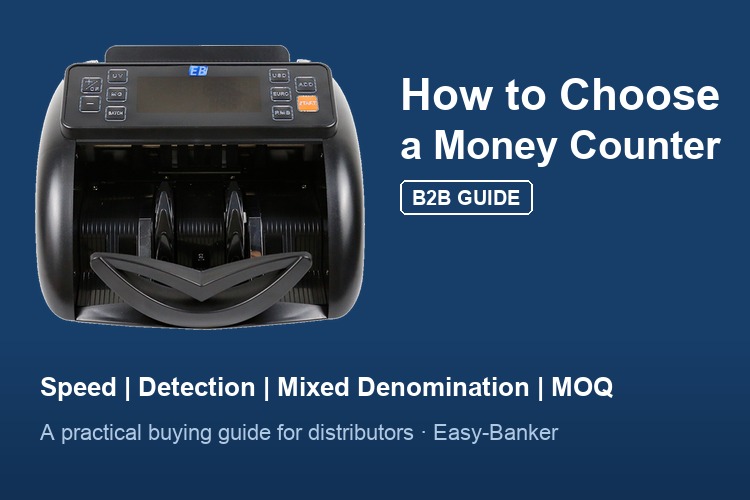
How to Choose a Money Counter: A Practical Buying Guide for B2B Buyers
Cash-handling equipment distributors, bank procurement teams and retail chains all face the same question: with dozens of money counter models on the market, how do you choose the right one — and how do you choose a supplier you can reorder from for years?
This guide walks through the seven decisions that actually matter when specifying a banknote counter for commercial use. Easy-Banker is a China-based manufacturer of currency counters, coin counters, banknote sorters and detectors, supplying distributors and institutions in the USA, Southeast Asia, South America, Africa, the Middle East and Europe.
1. Define the Workload First, Not the Feature List
The most common purchasing mistake is starting with features. Start with volume:
- Retail back office / supermarket cashier: a few hundred notes per closing shift. A compact counter such as the LD-30 handy counter or LD-10 money counter is usually sufficient.
- Bank branch / cash office: thousands of notes daily, mixed denominations, fitness sorting requirements. Look at bank-grade machines like the LD-5182 high-volume currency counter, rated at 1,000 notes per minute.
- Cash-in-transit and processing centers: continuous operation. You need a machine rated for extended running and, in many cases, a full note sorting machine rather than a counter.
Counting speed in context
Commercial money counters typically run between 600 and 1,500 notes per minute. Higher speed only matters if operators actually feed full batches continuously; for a shop counting one till at a time, reliability and low noise matter more than raw speed.
2. Counterfeit Detection: Which Technologies, for Which Currency?
Different banknote families carry different security features, so detection is not a checkbox — it is a match between sensor set and currency:
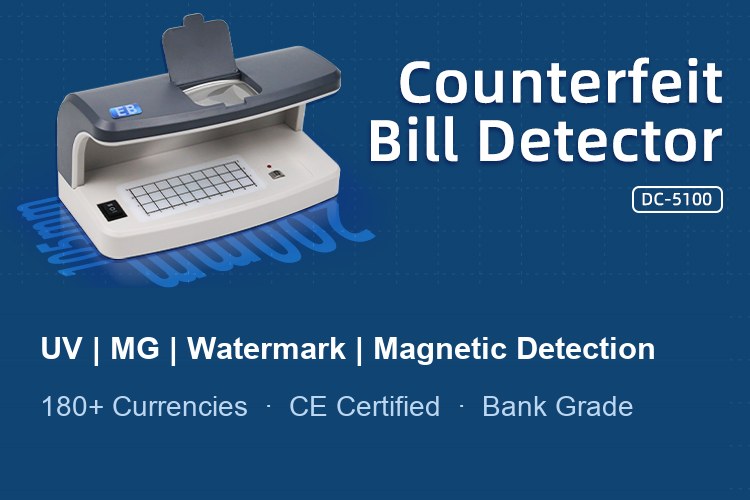
- UV (ultraviolet): detects fluorescent security marks in the paper.
- MG / magnetic: reads magnetic ink patterns used in USD, EUR and many other currencies.
- IR (infrared): verifies infrared-absorbing print on modern notes.
- Size / dimension detection: flags notes that are too short, too long, doubled or chained — this is also what catches most feeding errors.
If your market handles multiple currencies, specify a multi-currency model with UV + MG + IR, for example the LD-2610 business-grade multi-currency bill counter. For a deeper explanation of how these sensors work, see our article on how banknote counters detect counterfeit bills.
3. Piece Counting vs. Value Counting vs. Mixed Denomination
- Piece counter: counts the number of notes regardless of denomination. Cheapest, fine for single-denomination work.
- Value counter: multiplies pieces by a set denomination and displays the total amount — useful in banks and finance offices. See value note counters.
- Mixed denomination counter: recognizes each note's face value in a mixed stack and totals the amount automatically. Models such as the LD-7000 advanced bill counter go further and record serial number (SN) codes, which banks and cash-in-transit companies increasingly require for audit trails.
A mixed denomination money counter for banks costs more, but it removes the pre-sorting step entirely — labor savings usually justify the price within months in a busy cash office.
4. Back Feeding vs. Front Feeding
Feeding direction changes the ergonomics of the counter position:
- Back feeding (top-load hopper): the classic design; operator drops a stack into the top hopper. Most of Easy-Banker's back feeding bill counters follow this layout.
- Front feeding: notes are fed from the front, which suits built-in counter positions and tight teller desks. See front feeding currency counters.
We cover the operational differences in detail in what's the difference between front and back loading machines.
5. Physical Specifications Worth Checking
Before ordering, verify the datasheet against your banknotes:
- Countable note size: e.g. the LD-5182 accepts notes from 50 × 110 mm up to 90 × 180 mm.
- Note thickness: 0.075–0.15 mm on the LD-5182 — confirm compatibility if your market circulates polymer notes; models like the LD-2300 are built with polymer compatibility in mind.
- Power supply: dual-voltage AC 220V–110V, 50–60 Hz machines ship to any market without a transformer — an important detail for distributors covering both 110V (Americas) and 220V (Europe/Asia/Africa) regions.
- Display: external or double-screen displays (e.g. LD-6890) let the customer watch the count — valuable at bank counters and cash desks.
6. Certifications and Compliance
For import into the EU and USA, ask the supplier for CE, FCC and RoHS documentation, and confirm the factory runs a quality system such as ISO 9001. Request copies before your first order — a serious manufacturer provides them without hesitation.
7. Supplier Criteria: What Distributors Should Ask
If you are buying money counting machines wholesale to resell, the machine is only half the evaluation:
- MOQ: Easy-Banker works with distributor-friendly minimums — from 10 units on multi-currency models like the LD-2110 and LD-100, 20 units on compact counters like the LD-30.
- OEM/ODM: can the supplier print your brand, customize firmware currency settings and packaging?
- Product breadth: one supplier covering counters, sorters, coin machines and detectors simplifies your catalog and container consolidation. Browse the full banknote counter range.
- Spare parts and after-sales: ask about sensor and roller availability — wearing parts decide the real lifetime cost.
- Do you need to sort before counting? Only on piece counters; mixed-denomination machines count unsorted stacks. More in our sorting vs. counting article.
Quick Decision Table
| Use case | Recommended type | Example model |
|---|
| Shop / supermarket till | Compact piece counter, UV | LD-30, LD-10 |
| Office / small bank branch | Multi-currency value counter, UV/MG/IR | LD-2610, LD-5182 |
| Bank cash office / CIT | Mixed denomination + SN recording | LD-7000, LD-6000 |
| Mobile / field counting | Portable rechargeable counter | LD-100 |
Request a Quote
Tell us your market, currency and daily volume, and we will recommend the right model and send a wholesale price list with MOQ, lead time and OEM options.
Contact Easy-Banker: Contact Us page | Email: tony@easy-banker.com | Tel: +86-139-1679-5626